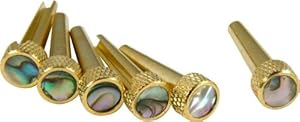
What do ya’ll prefer - slotted / unslotted - beveled / unbelved - plastic, wood, brass, camel bone, ivory (yes it can be found)? I just finished changing the strings on my new 12 string and noticed that my bridge pins were pretty worn. Didn’t have any new pins on hand so I re=used what I had. The next time I change string I do plan on changing out to something other harder materal than what I have now. I can ge a set of ebony for about $30.00/six pack, camel bone for about $45.00/six pack and ivory starting at $90.00/sixpack. SInce I need an even dozen this could get expensive. The plastic ones really inexpensive but they don’t improve sound. I’m kinda leaning toward’s ebony pins.
bensonp wrote:
I guess I never thought of pins actually improving sound.ill probably stick with plastic.
I never gave that a thought either. I would have assumed that since the pins are below the bridge, they wouldn’t have any effect on sound transfer. Looking forward to hearing other thoughts on this.
Hi nela, I use brass pins on my 6string and 12string. Ebony pins were also good. I wouldn’t have thought pins made a difference until I started to experiment. I don’t want to sound like a commercial/endorsement but I purchase strings and other accessories from stringsandbeyond.com. I don’t like to leave the mountain unless I have to, so I just have stuff delivered to my mailbox whenever possible.
Changing out the bridge pins, saddle and the nut with harder materials WILL inprove the sound, sustain and overall clarity of your guitar. Bone, tsqu, ivory work well on the saddle and nuts. Plastic bridge pins wear out easy and if the ball end of the string is not set against the bottom of the bridge plate correctly can cause slippage, Even with the harder bridge pins it is very important to set the ball ends in the right way. Beveling the ends of bridge pins will help in this. It’s always the little thangs.
I would like brass on one of my guitars. I have found a HUGE improvement in sound going from cheap junk plastic dead junk to bone or ebony. Boomer has bone. Tiny has ebony. Ol’ Reliable has ebony. I want brass on Ol’ Reliable to brighten her up.
Anyway, slotted, hard, natural goodness is what you want. Get bone if you can.
I have an older Ventura acoustic that I picked up second hand in 1979. About three years ago I brought it in to have a set up done. It was suggested that a bone nut and bridge and ebony pins would make a world of difference. Well, it really did! Even though she now is semi retired to play the occasional camp fire. She still rings out loud and true. 130 bucks well spent!
I also wouldn’t have thought that the bridge pin material would affect the sound. The business-part of the string (that does the vibrating) is between the nut and the bridge, so unless the bridge pins aren’t holding well, that’s what one would expect. Something to look into.
Hmmm… I’ve experimented with plastic, bone, rosewood, ebony and buffalo horn pins but haven’t tried brass yet. Looks like they’re cheap enough to give it a try.
When ordering bridge pins or just purchasing OTC you need to know if your old ones are 3 degree or 5 degree pins. It is very inportant to get the right ones. I just read a good article on the proper way to install new strings and bridge pins (don’t remember the site) that also showed how to bevel the ends of the pins so the ball ends of the string don’t hang up.
NELA wrote:
When ordering bridge pins or just purchasing OTC you need to know if your old ones are 3 degree or 5 degree pins. It is very inportant to get the right ones. I just read a good article on the proper way to install new strings and bridge pins (don’t remember the site) that also showed how to bevel the ends of the pins so the ball ends of the string don’t hang up.
nela
96 to go
If you should happen to come across the article again, could you post a link? I didn’t realize there were different ones. I’m not even sure I know what you mean by 3 or 5 degree pins. Thanks.
Joe
The angle of the taper varies by Manufacturer… but here’s a tip: Gibson and a majority of the others use the 3s, Older vintage guitars and newer Martins are wearing 5 degree pins. Compare one of yours with a sample at your local store to get the correct ones first shot.
Cool video, funny how such little things can go missed.
I’ve never bought a set of pins but I would dare to say that the difference between 3 and 5 degrees on a pin that is only 1/4" in diameter and 1" long is going to be very hard to distinguish. I understand that you need to get the right ones as they are not interchangeable. The link Beamer shared didn’t say what degree those are.
Maybe thats why the pins in my fender 12 were always cracked when I took them out? I just figured it was due to the amout of psi on the bridge. (but seeing as how my bridge pulled away from the body, that could be the problem also since the pins were probably holding a lot of the pull tension from the bridge)
I suspect that most shops just grab a set of 5 degree pins off the shelf and ream to fit. My Luthier is a little OCD about stuff like that (he’s really into restoring vintage instruments) and owns a set of taper guages and reamers for various instruments. Another option would be to take your guitar down and pull a pin and test fit a new one of known taper… if it wobbles you want the other ones, and if it wobbles just a tiny bit… they’re the right ones but need to be reamed a hair.